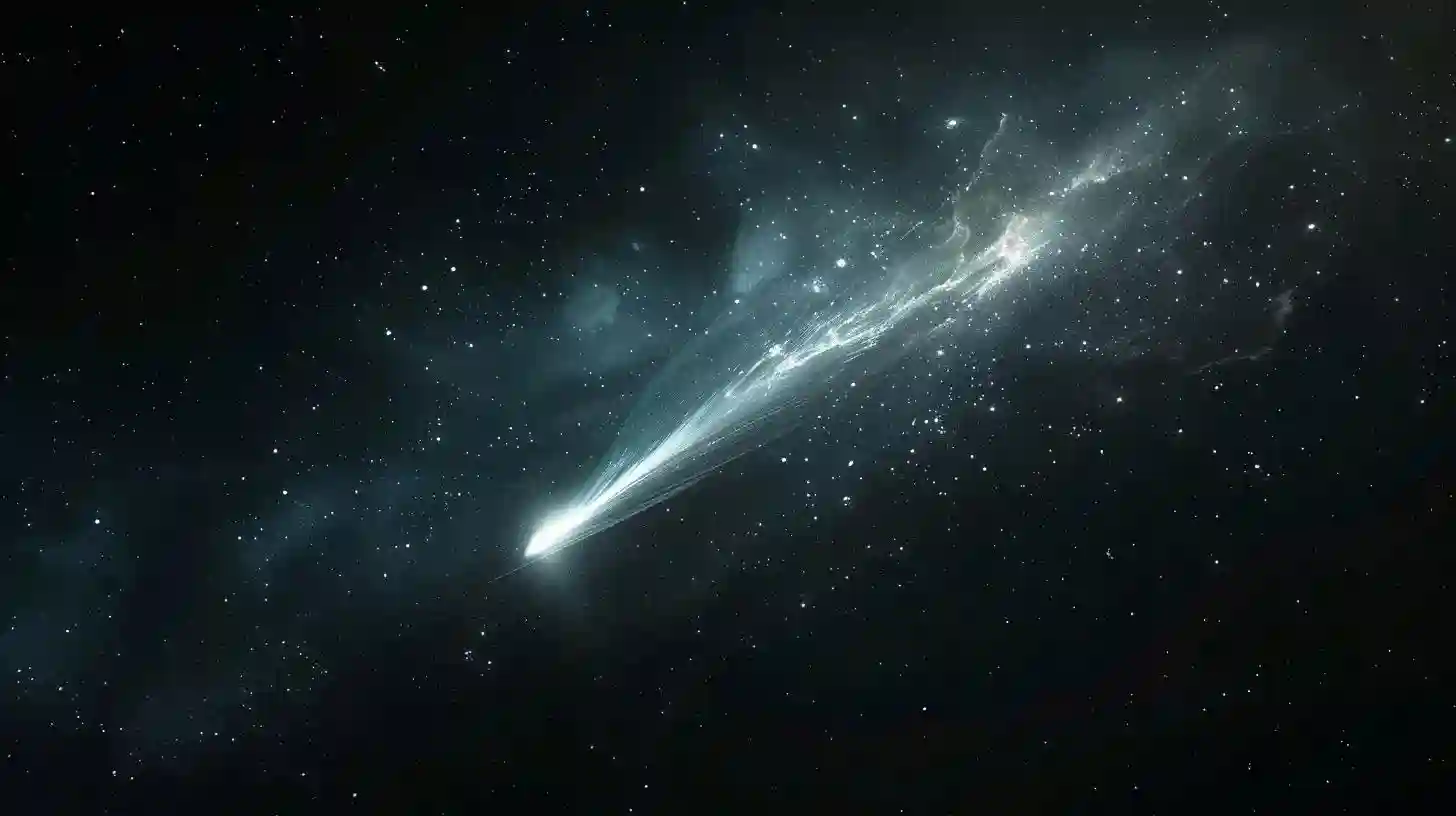
Comets have long captured the imagination of people throughout history. These celestial objects, made of ice, rock and dust, have captivated astronomers and the general public with their shiny tails and mysterious origins. Comets were seen as omens of doom and harbingers of change, and their appearance in the night sky gave rise to myths, legends and scientific research.
One of the most famous comets in history is Halley's Comet. Halley's Comet, named after the British astronomer Edmond Halley who predicted its return in 1758, has been observed and recorded by humans for thousands of years. Its appearance in the sky is a rare and spectacular event, occurring only once every 76 years. Halley's Comet was last seen in 1986 and is expected to return in 2061.
Comets are often called "dirty snowballs" due to their composition. They are made of a mixture of ice, rock and dust, which gives them a distinctive appearance as they enter the inner solar system. As the comet approaches the Sun, the heat causes the ice to evaporate, creating a glowing coma, or cloud of gas and dust, around the nucleus. This coma can be hundreds of thousands of kilometers across and is illuminated by the Sun, creating the bright tail for which comets are famous.
Comets are thought to originate from the outer regions of the solar system, in a region known as the Oort Cloud. This huge cloud of icy bodies surrounds the Sun at a distance of up to 50,000 astronomical units (AU), or about 1.5 light years. Sometimes, gravitational interactions with other objects in the galaxy can disrupt a comet's orbit in the Oort Cloud, sending it on a trajectory leading into the inner solar system.
Comets can be divided into two main types: short-period and long-period. Short-period comets have orbits that take them into the inner Solar System over relatively short periods of time, typically less than 200 years. These comets are thought to originate from the Kuiper Belt, a region of the outer solar system beyond Neptune that is home to a large number of icy bodies. On the other hand, long-period comets have orbits that take them into the inner Solar System over much longer periods, sometimes thousands or even millions of years. These comets are believed to originate from the Oort Cloud.
Comets have been observed and recorded by humans for thousands of years. In ancient times, comets were often seen as omens of doom or symbols of divine wrath. It was believed that the appearance of a comet foreshadows a catastrophe, war or the death of a ruler. Some cultures even associated comets with the end of the world. For example, the appearance of Halley's Comet in 1066 was thought to predict the Norman conquest of England.
Although comets are associated with disaster and death, they are also considered symbols of change and renewal. In many cultures, comets were seen as messengers from the gods, announcing important events or signaling the beginning of a new era. In some myths and legends, comets were even considered to be the spirits of departed loved ones, watching over the living from the heavens.
Nowadays, comets have become objects of scientific research. Astronomers study comets to learn more about the formation and evolution of the solar system. By analyzing the composition of comets, scientists can gain insight into the conditions that existed in the early solar system and the processes that shaped its evolution. Comets are also of interest because they are thought to contain organic molecules, the building blocks of life. Some scientists believe that comets may have played a role in the origin of life on Earth, delivering water and organic molecules to the early planet.
One of the most famous missions to study the comet up close was the European Space Agency's Rosetta mission. Launched in 2004, the Rosetta spacecraft traveled to comet 67P/Churyumov-Gerasimenko, where it deployed the Philae lander to study the comet's surface. The mission provided valuable data on the comet's composition and structure, shedding light on its origins and evolution. In 2014, the Rosetta spacecraft became the first to fly by the comet and study its approach to the Sun in detail.
Comets continue to capture the imagination of the public and scientists. Their mysterious origins, shiny tails and rare appearances in the night sky make them objects of wonder and fascination. Whether they are considered omens of doom or messengers of change, comets have played a significant role in human history and culture. As our understanding of these celestial objects grows, so does our understanding of the beauty and complexity of the cosmos.