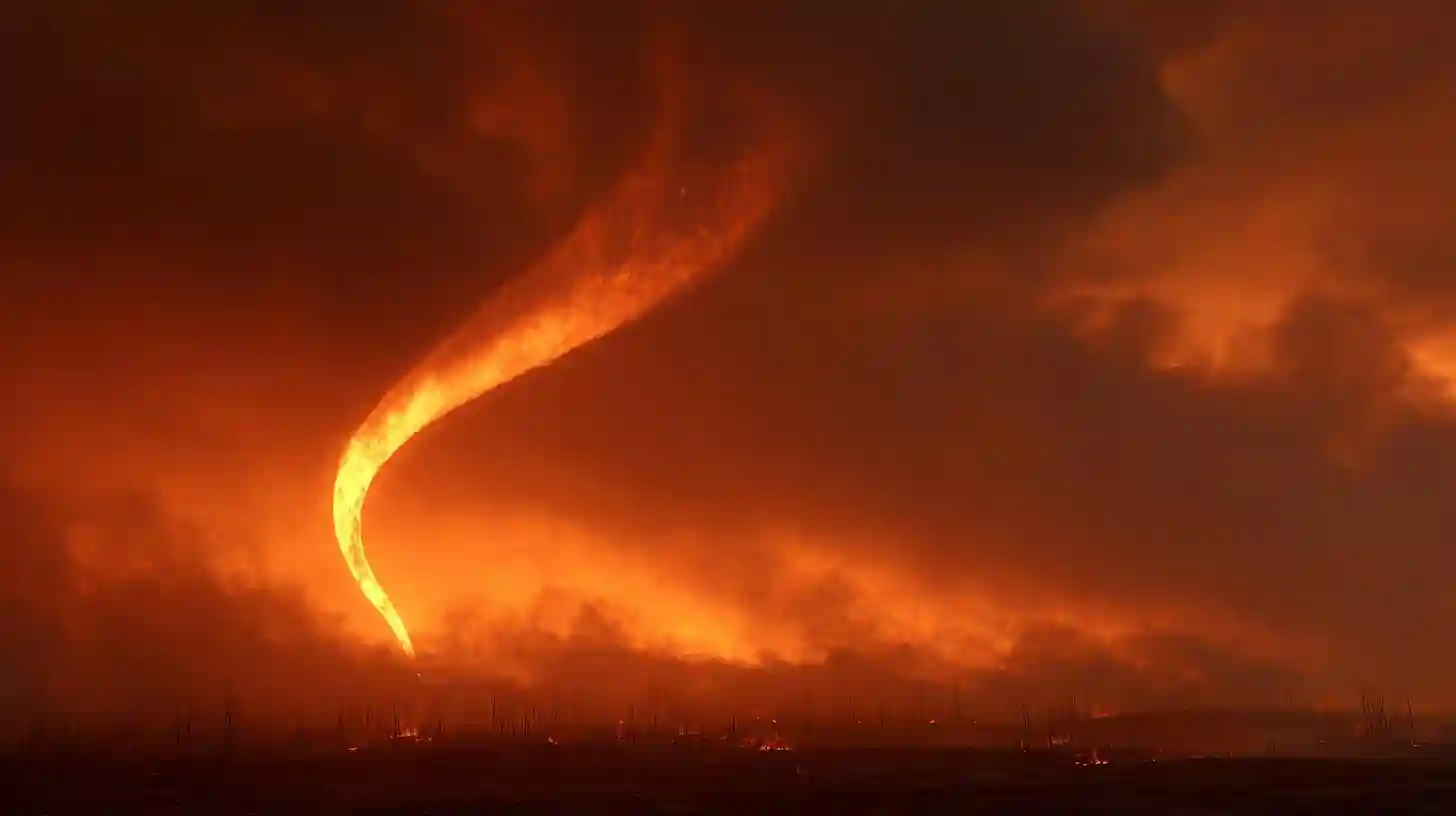
Fire whirlwinds, or fire tornadoes, are an extraordinary and terrifying phenomenon that has recently gained more attention due to their occurrence during devastating wildfires around the world. These rare yet awe-inspiring occurrences can be as dangerous as they are mesmerizing, capturing the imagination of those who witness them and leaving a trail of destruction in their wake. Fire whirlwinds are essentially rotating columns of fire that can form when intense heat and turbulent winds combine in a particular way. They are a fusion of natural forces, where the violent updraft of hot air interacts with wind patterns, creating a rotating column of flame. The resulting vortex can range in size, but even the smallest can reach speeds and intensities that make them just as perilous as a tornado itself.
The formation of fire whirlwinds is typically linked to extreme wildfires, where large-scale fires burn in areas with dry, hot conditions. When a fire grows to an enormous scale, the heat generated can create powerful updrafts of air. As the air rises rapidly, it can start to spin, and when conditions align perfectly, the spinning air can intensify into a fire whirl. This vortex, propelled by the fierce winds surrounding the blaze, can rise several hundred feet into the air, with flames spiraling around the center like a massive funnel. The vortex is often seen as a terrifying display of nature’s raw power, moving with an unpredictable, chaotic force.
Despite their dramatic appearance, fire whirlwinds are not something entirely new. They have been documented for centuries, with early records from the 19th century describing such occurrences during large wildfires. However, the recent intensification of wildfires, particularly in regions like California, Australia, and parts of the Mediterranean, has brought more attention to this phenomenon. Researchers have found that the frequency and severity of fire whirlwinds have been increasing as a result of climate change, which contributes to hotter, drier conditions and more intense fire seasons. The combination of more frequent wildfires and more extreme weather patterns is likely to make fire whirlwinds a more common sight in the coming years.
These fiery twisters are not only a natural wonder but also a serious threat to both human life and property. In many cases, the fires they accompany are already out of control, and the emergence of a fire whirl can make the situation even more dangerous. Fire whirlwinds are capable of moving swiftly, carrying with them embers and flames that can spark new fires far beyond the main blaze. Their unpredictable nature makes them extremely difficult to predict and control. Emergency responders face considerable challenges when trying to combat wildfires with fire whirlwinds in the mix. The combination of high winds, fast-moving fire fronts, and the sudden appearance of these whirlwinds creates a chaotic environment that tests the limits of firefighting capabilities.
The appearance of fire whirlwinds can be terrifying for those who witness them. They are often described as a towering, spinning column of flames, sometimes accompanied by a roaring sound as the fire intensifies. The vortex can pull in debris, such as trees and large rocks, which can make the fire whirl even more dangerous. In the worst cases, the fires can grow so large that they form into what are known as pyroconvective plumes, which can generate their own weather systems, including lightning strikes and further tornado-like structures. This escalation only adds to the unpredictability and intensity of the fire.
One of the most striking aspects of fire whirlwinds is their ability to move and change direction unexpectedly. While tornadoes generally follow a more defined path, fire whirlwinds are influenced by a combination of factors, including wind direction, terrain, and the behavior of the fire itself. This randomness makes them difficult to track and even harder to prepare for, especially in areas where firefighting infrastructure is already stretched thin. There is also the risk that a fire whirl may carry the fire into areas that had previously been thought to be safe, spreading the danger beyond anticipated boundaries.
As more and more research is conducted into fire whirlwinds, scientists are gaining a deeper understanding of the conditions under which they form. Advances in technology have also made it possible to study these phenomena in greater detail, using drones, satellites, and other monitoring equipment to track their behavior. This research is crucial for developing strategies to mitigate the effects of fire whirlwinds and improve wildfire prediction and management. It is also vital for understanding how climate change may be contributing to their increasing occurrence.
Despite the immense danger fire whirlwinds pose, they remain one of the most fascinating and destructive forces of nature. Their ability to combine fire and wind in such an extreme way makes them one of the most powerful and terrifying spectacles of the natural world. As global temperatures rise and wildfires become more frequent, fire whirlwinds may continue to emerge with greater frequency, posing an even more significant threat to communities and landscapes around the globe. Scientists, fire experts, and emergency responders alike will need to continue to study and adapt in order to better understand and combat these fiery twisters in the years to come.