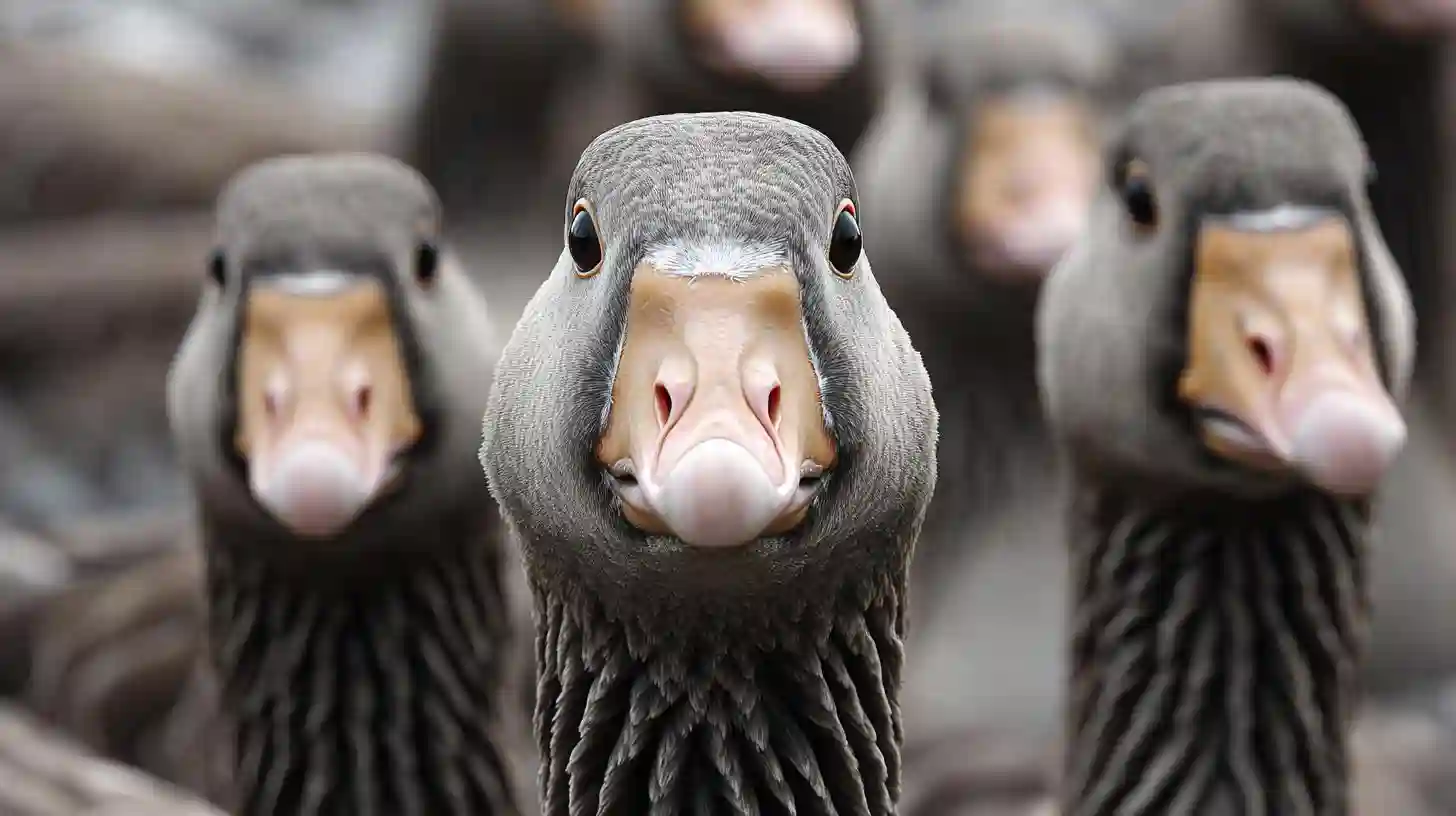
Recent studies have been revealing unexpected findings about animal intelligence, and one of the most intriguing subjects is the humble goose. These birds, often seen honking in flocks or migrating in intricate patterns, have long been underestimated in terms of their cognitive abilities. However, new research has begun to shed light on their complex mental processes, challenging the age-old assumption that geese are simple, instinct-driven creatures.
For years, people have admired the goose's migratory patterns, with their impressive long-distance travel across continents. What was often overlooked, though, was the strategic and adaptive nature of this behavior. A recent study highlighted that geese are capable of making highly calculated decisions during migration. The birds are not merely following an innate, pre-programmed path; instead, they are engaging in a dynamic decision-making process, adapting to changing weather conditions, food availability, and even altering their routes based on experiences from previous migrations. This level of flexibility suggests that geese possess a level of cognitive sophistication that was previously unknown.
Further examination into their social structures has also revealed that geese maintain complex relationships within their flocks. These birds often work in tandem with one another, exhibiting behaviors that suggest a high degree of cooperation and even empathy. In a phenomenon known as "V formation," geese fly in a V-shaped pattern, which significantly reduces the aerodynamic drag on each bird. While this behavior was initially thought to be simply a survival mechanism, studies have now shown that geese rotate positions in the formation, taking turns leading and following, depending on their energy levels. This cooperative rotation hints at an awareness of one another's physical state and a mutual concern for the welfare of the flock.
Geese have also been observed to communicate in a highly sophisticated manner. Their honking, often thought of as mere noise, is actually a complex system of signals that convey a variety of messages to the flock. These calls can indicate a range of things, from the presence of a predator to a shift in direction during flight. The nuances of these calls suggest a level of social intelligence that is often overlooked. The ability to communicate in such a nuanced way not only demonstrates their cognitive capacity but also their reliance on a shared understanding of the environment around them. Through these vocalizations, geese can coordinate their actions, ensuring the safety and efficiency of the group.
The intelligence of geese extends beyond their social behaviors and communication. Recent experiments have shown that these birds are capable of problem-solving, a trait that was once considered exclusive to more traditionally "intelligent" animals like primates. In controlled tests, geese have been presented with puzzles that require them to use tools or manipulate objects to obtain a reward. The birds consistently demonstrated an ability to think critically about the problem at hand, suggesting a level of reasoning that is far more advanced than initially assumed. These experiments challenge the conventional view of animal intelligence and suggest that cognitive abilities are not limited to a select few species.
Geese also exhibit a remarkable ability to recognize individuals within their flock. In studies where geese were exposed to various members of their species, they displayed clear preferences and recognition, favoring certain individuals over others. This level of social recognition points to a sophisticated understanding of their social dynamics, allowing them to form bonds and alliances within their groups. This behavior is particularly intriguing when considering the role of memory in the geese's social interactions. They are capable of remembering previous interactions, whether positive or negative, and adjust their behavior accordingly, which is indicative of higher cognitive functioning.
The findings from these recent studies have far-reaching implications, not just for our understanding of geese, but for the broader study of animal intelligence. These birds have shown that intelligence can manifest in a variety of forms, not always in the ways we expect. While we often measure intelligence based on problem-solving abilities or communication skills, the true nature of cognitive prowess may lie in a more holistic understanding of how animals interact with their environment and each other.
The new insights into goose intelligence are likely to spark further research into the mental lives of other animals. If geese, long regarded as simple and predictable creatures, are capable of such advanced cognition, then what might be hiding in the minds of other animals? As scientists continue to unravel the mysteries of animal intelligence, it is clear that geese, once seen as simple travelers of the skies, are far more intelligent and complex than we ever gave them credit for.