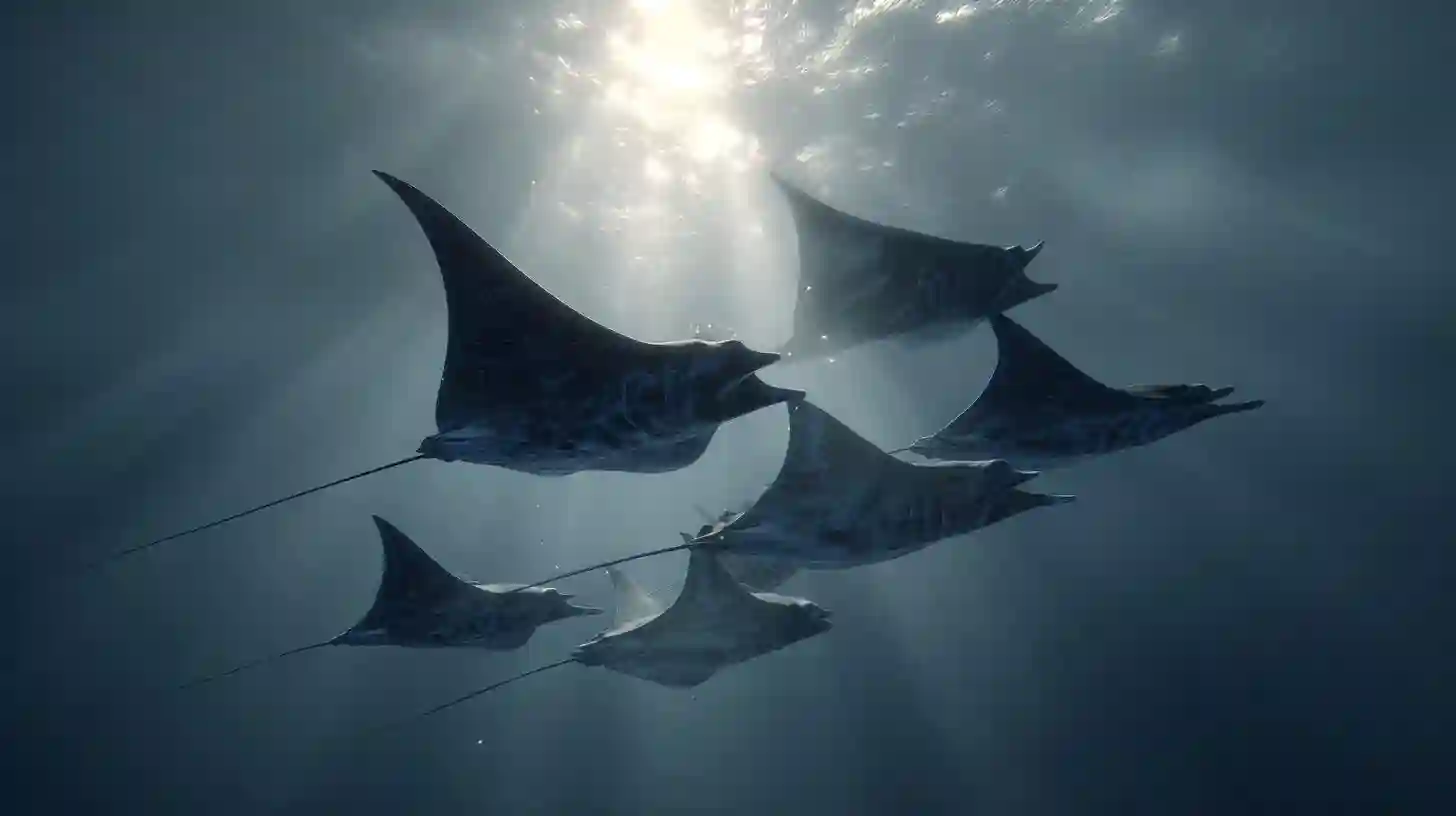
Mobulas are often seen as the "alien" inhabitants of the deep, their elegant movements and mysterious behavior stirring awe among those lucky enough to witness them in the wild. These fascinating creatures belong to the family Mobulidae, a group that includes the mobula rays and the manta rays. While they share some similarities with their more famous cousins, the manta rays, mobulas have distinct characteristics that make them intriguing and enigmatic. As ocean dwellers, mobulas have developed behaviors and traits that remain relatively unknown to many, sparking curiosity about their true nature and potential secrets.
Mobulas are most commonly recognized by their flattened bodies and sweeping, wing-like pectoral fins, which allow them to glide gracefully through the water. The way they swim, with their fins raised as if soaring, gives them an almost bird-like appearance. But beneath this striking exterior lies a complex animal that has adapted to its environment in ways that continue to challenge the understanding of marine biologists.
One of the most captivating aspects of mobulas is their ability to leap out of the water, a behavior known as breaching. While it's a phenomenon shared with other species like dolphins, mobulas' jumps are particularly spectacular, with some individuals launching themselves several meters into the air. Scientists have speculated that this behavior could serve a variety of purposes, from dislodging parasites to communicating with other mobulas or even intimidating predators. However, the exact reason for their frequent aerial acrobatics remains a subject of ongoing research.
What makes mobulas even more fascinating is their social structure. These creatures are not solitary; instead, they form large schools that can consist of hundreds, sometimes thousands, of individuals. These schools are fluid and dynamic, with individuals swimming together in synchronized patterns that resemble the movements of a single organism. This coordinated behavior has puzzled researchers, who are still trying to decipher how mobulas communicate and coordinate such complex movements without relying on a rigid social hierarchy or overt communication signals.
Another interesting feature of mobulas is their feeding strategy. Mobulas are filter feeders, much like their larger relatives, the manta rays. They use their large mouths to scoop up plankton and small fish as they swim through the water. Their gills, equipped with specialized structures known as gill rakers, allow them to filter out tiny organisms from the water. While their feeding method is similar to that of manta rays, the mobula’s approach to hunting often takes place in deeper, colder waters, further adding to the sense of mystery surrounding their feeding habits.
Mobulas also exhibit a level of intelligence that sets them apart from many other marine creatures. They have been observed engaging in behaviors that suggest a degree of problem-solving and social interaction. For example, some mobulas have been seen using their bodies to create whirlpools, potentially to concentrate prey or even to help them communicate within their groups. This level of behavioral complexity hints at a more sophisticated understanding of their environment than what was initially assumed.
Perhaps most intriguing, however, is the idea that mobulas may possess abilities beyond those of typical marine animals. Some researchers have suggested that these creatures are capable of navigating the vast and open ocean with an uncanny precision. Their migratory patterns have been known to cover great distances, suggesting a sense of direction and awareness that could be far more advanced than previously thought. The use of environmental cues, such as the Earth’s magnetic field or the position of the stars, is still being investigated, but there are growing suspicions that mobulas may be attuned to the oceans in ways that few other species are.
What’s more, the lives of mobulas are not without their own dark mysteries. Despite their impressive abilities and adaptations, these creatures are facing increasing threats. Overfishing, habitat destruction, and the impacts of climate change are all having an effect on their populations. In particular, mobula rays are often caught unintentionally in fisheries targeting other species. Their slow reproductive rates only add to the challenge of maintaining stable populations. Many countries have taken steps to protect mobulas through conservation efforts, but the long-term future of these ocean aliens remains uncertain.
As humans continue to explore the depths of the oceans, the mysteries of creatures like the mobula will likely continue to unfold. These elusive beings embody the unknowns of the sea, offering a glimpse into a world that is still largely unexplored. Whether they are simply a strange and beautiful species or something more, mobulas remind us that the oceans are filled with wonders waiting to be discovered, and their true nature may be far more complex than we can imagine.