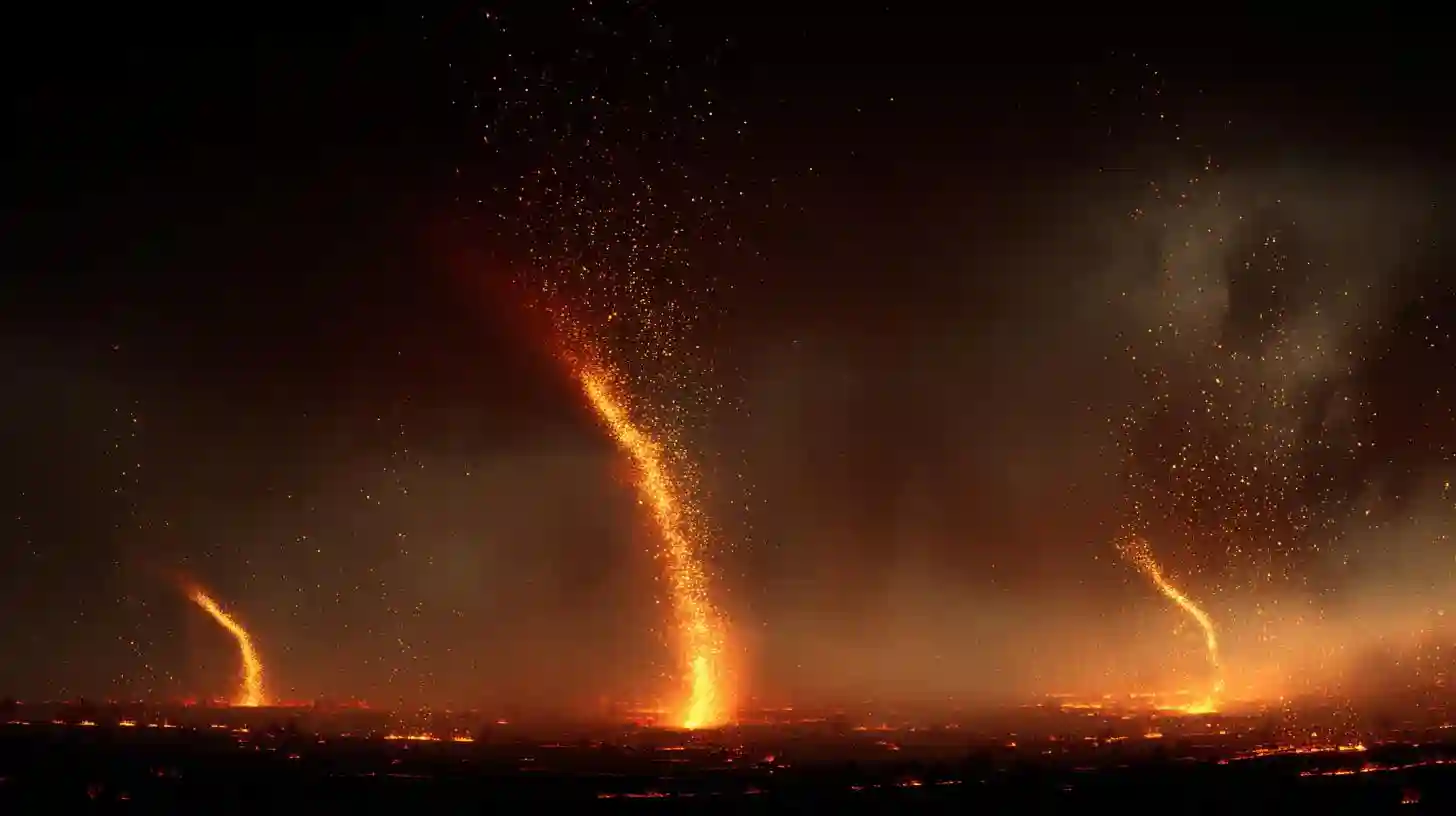
Fire whirls, also known as fire tornadoes, have become increasingly visible as extreme wildfire conditions intensify across various regions. These phenomena occur when intense heat from a wildfire combines with turbulent winds, creating a spinning column of fire that can reach extraordinary heights. Unlike conventional tornadoes, fire whirls carry flames, ash, and embers, allowing them to spread fires with a speed and ferocity that can overwhelm firefighting efforts. The twisting motion of a fire whirl generates its own microclimate, drawing in air and feeding the flames, which further accelerates the combustion process and creates highly unpredictable behavior. Their formation is influenced by factors such as topography, vegetation density, wind patterns, and the intensity of the wildfire itself, making them difficult to forecast and control. Observers often describe fire whirls as surreal and terrifying spectacles, resembling spinning funnels of molten energy that defy the usual understanding of fire dynamics. They can lift burning debris high into the air, creating secondary fires far from the original blaze, which dramatically increases the threat to both natural landscapes and human settlements. Fire whirls are known to vary in size, ranging from small, localized vortices that can be measured in meters to towering columns that stretch dozens of meters into the sky, carrying immense thermal energy and destructive potential. The swirling winds within these fire formations can reach velocities comparable to weak tornadoes, but the addition of extreme heat and flying embers makes them uniquely hazardous. Scientists study fire whirls to better understand the complex interactions between fire, wind, and terrain, aiming to improve predictive models and firefighting strategies. Despite their chaotic nature, certain patterns have been observed, such as the tendency for fire whirls to form in narrow valleys, canyons, or areas with abrupt changes in landscape elevation, where wind currents can become concentrated and turbulent. The intense heat generated by these phenomena can create rising columns of hot air that contribute to the formation of pyrocumulus clouds, which further influence weather patterns and can lead to erratic wind shifts that exacerbate the wildfire's spread. In addition to their immediate destructive impact, fire whirls pose significant risks to ecosystems, often burning trees, shrubs, and grasses with unprecedented intensity and leaving behind landscapes stripped of vegetation. Wildlife is forced to flee rapidly, and the resulting habitat loss can have long-term consequences for species survival and ecological balance. Human communities near wildfire-prone areas face heightened danger as fire whirls can leap over natural firebreaks and roads, making conventional containment methods less effective. Firefighters are required to adapt constantly to the unpredictable behavior of these fiery vortices, employing specialized equipment, aerial support, and advanced monitoring techniques to track their movement and protect lives. The visual spectacle of a fire whirl can be both mesmerizing and terrifying, a reminder of nature's raw power and the intricate interplay between fire, wind, and topography. Researchers continue to analyze historical wildfire events to identify conditions most conducive to fire whirl formation, seeking patterns that might inform evacuation protocols, emergency response planning, and land management practices. Fire whirls also highlight the importance of understanding fire behavior in the context of climate change, as rising temperatures, prolonged droughts, and changing vegetation patterns can create the conditions necessary for these extreme fire events to occur more frequently. Public awareness and education are critical in preparing communities for the possibility of encountering fire whirls, as understanding their speed, unpredictability, and destructive capability can save lives. Each encounter with a fire whirl underscores the necessity for rapid decision-making and effective communication during wildfire emergencies, reinforcing the urgent need for coordination between authorities, residents, and firefighting agencies. The mesmerizing yet deadly nature of fire whirls serves as a stark illustration of the challenges faced by those confronting wildfires, emphasizing both the power of natural forces and the ingenuity required to mitigate their impact.